Sunday, October 26, 2025

DP25028 Compendiums by John Brockman V01 261025

 Just purchased Real Time by John Brockman and Edward Rosenfeld. An amazing book but not his first compendium. 


No — Real Time: Talking About the Universe (1984), edited by John Brockman and Edward Rosenfeld, was not John Brockman’s first compendium.


Before Real Time, Brockman had already edited and published several anthologies and works that could be considered compendia, such as:

About Time: Essays on Science and Philosophy (1973) — one of his earliest anthologies, also co-edited with Edward Rosenfeld.

Afterwords: Explorations of the Future (1973) — another early Brockman/Rosenfeld collaboration, collecting essays on science, technology, and culture.


These earlier works established the style and themes Brockman would continue exploring — bringing together scientists, philosophers, and thinkers to discuss the frontiers of knowledge — long before Real Time.


Saturday, October 25, 2025

DP25027 A 1973 Catalog of Ideas and Information. V01 251025

 A very unusual  Book Catalogue listing 129 books representing much of the leading areas of ideas and information in 1973. It’s a snapshot of where things stood in respect of many ideas and technologies in 1973 and in that respect it is an interesting historical artefact. Amazingly it lists Isaac Asimov’s Biographical Encyclopaedia of Science and Technology. (1967) listing 1195 biographical sketches. Isaac never did anything insignificant !!


Here’s a summary and commentary on Real Time 1: A Catalog of Ideas and Information (and by extension “Real Time” as used) by John Brockman & Edward Rosenfeld (1973).


Bibliographic & background info

Real Time 1 was published in 1973 by Anchor Press/Doubleday (in the U.S.). 

John Brockman (born 1941) is a literary agent and author, known for bridging science/tech and culture. 

Edward Rosenfeld appears as co-author/co-editor.

The book’s subtitle is “A Catalog of Ideas and Information”. 

It seems to have a companion volume, “Real Time 2: A Catalog of Ideas and Information”. 


What the book is about

It is less a traditional narrative book, and more a curated collection or catalogue of ideas, quotes, fragments, observations — many drawn from then‐emerging fields (cybernetics, systems theory, communications, computer culture). 

The idea is to capture how “real time” (in terms of information, communication, technology) is affecting society: the acceleration of information, new communication media, computational thinking, etc.

For example, one study paper notes: “REAL TIME 1 & REAL TIME 2: … A Catalogue of Ideas and Information” referencing the book. 

It reflects the late 1960s/early 1970s concern with “the information age”, cybernetics, media theory and how man, machine, communication and society interplay. 


Key themes & significance

Acceleration of information: The book foregrounds that information flows, communication speed and real‐time media are transforming society.

Technology & human condition: It engages with how computing, cybernetics, networks change how we think about human, machine, consciousness. (Brockman’s earlier writing touches on such themes.) 

Catalogue form / non‐traditional format: Rather than linear argument, the catalogue format allows the reader to dip into many short “idea bites”, reflecting a fragmented, rapid‐info environment.

Historical snapshot: It gives insight into a period when thinkers were grappling with the future of technology & communication — so it has archival value for those studying media/cyberculture.

Bridge between disciplines: Because Brockman is known for linking science/tech with broader cultural concerns, this work helps show the cross‐disciplinary currents of the time.


Limitations / things to keep in mind

Because of its catalogue style, it may not offer deep sustained argument or case‐studies like a monograph would.

Being published in 1973 means many of the technological assumptions are from that era; some ideas may now feel dated or speculative.

For someone looking for a practical “how‐to” guide or a recent forecasting work it may feel less directly usable, but more as a historical “idea source”.


For you: Why it might be useful

If you’re interested in how thinkers in the early “information age” thought about real time, media, communication and technology, this book is a useful reference.

If you are exploring the genealogy of cyberculture, media theory, or the shift towards “real‐time” society (streams, networks, instant communication) this book offers early material.

If you like browsing collections of provocative quotes, ideas, fragments (rather than long treatises), this is aligned with that style.


If you like, I can check and pull up the table of contents of “Real Time 1”, maybe highlight some especially interesting excerpts, and see where you might get a copy (UK / second-hand) if you’re thinking of reading it. Would you like me to do that?

Friday, October 24, 2025

DP25026 Digital Publisher - RELX V01 241025

 AI buzz provides a big wake-up call

Buy, sell or hold: today’s best share tips

Emma Powell - Tempus 

RELX
Market cap £64 billion 
9-month revenue growth 7%

It takes a lot to jolt the sleeping giant that is Relx. The data specialist has quietly ascended to become one of London’s ten most valuable companies, with a market cap of more than £60 billion.

However, questions over whether the rise of generative artificial intelligence threatens to upend the group’s core business, selling information and analytics to professionals in the legal, insurance and medical industries, among others, have sparked a rare sell-off in the shares.

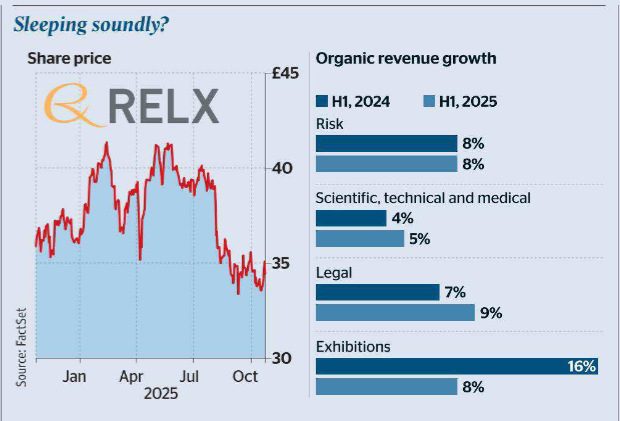
The shares have fallen about 15 per cent over the past six months, although that doesn’t make them cheap by conventional standards, still trading at roughly 25 times forward earnings, but that multiple is down from about 30 in April.

Yet Relx’s premium status is deserved. It has established a long record of stable revenue, margin improvement and sturdy cash generation. Charging customers a subscription fee for the use of its hefty legal, medical and scientific journals means a chunk of its revenue is recurring. Despite the recent headwind, the shares have risen 197 per cent over the past decade, easily outpacing the 51 per cent return generated by the FTSE 100.

The company makes relatively few headlines, and Erik Engstrom, the Swede who has led the business for the past 15 years, has never given a media interview as its chief executive.

Known as Reed Elsevier from 1992 until 2015, it was once a producer of books and magazines but has made a gradual transition away from physical media, selling one of its last print magazines in 2019. It now generates 83 per cent of its revenue through digital means, with face-to-face exhibitions accounting for 14 per cent and print just 4 per cent. Relx now has four divisions: scientific, technical and medical (otherwise known as “STM”); risk; legal; and exhibitions.

In the debate over whether the emergence of ChatGPT and other chatbots will make Relx’s information and analytics tools redundant, the group seems to be winning.

The risk division, which covers the company’s analytics and decision tools for areas such as digital fraud and identity checks that are mission critical for the banks and insurance companies that use them, has long used so-called extractive AI. Those products use machine learning to extract and analyse key bits of information, and were credited for helping kick the business’s underlying revenue growth, which stood at 8 per cent over the first nine months of the year.

However, it has extended its use of AI to its legal and STM businesses, which has driven an improvement in top line performance for both divisions. While its revenue growth has not shot the lights out, adding value through generative AI has pushed it to a rate of 9 per cent, from 2 per cent in 2019. Likewise, STM has improved to 5 per cent from 1 per cent over the same timeframe.

Within the mix, exhibitions may look out of place, not least because it carries more risk that a macroeconomic slump could hit revenues. However, there are no plans to sell it.

Covid hit aside, the business, whose trade shows range from Comic Con to the London Book Fair across 25 countries, has generated respectable top line growth. Over the first nine months of the year, underlying revenue rose 8 per cent, but over the last decade it has fluctuated to a greater extent than Relx’s other three arms.

One of the core tenets of Engstrom’s strategy is to keep a tight enough handle on operating costs that revenue growth outpaces it each year. The result has been consistent margin expansion, which stood at almost 35 per cent over the first six months of the year, compared with just under 32 per cent in 2019.

Its fiscal discipline extends to the way it uses its cash. It has eschewed large-scale M&A in favour of bolt-on deals that may give an edge to its products. Instead most of its cash is invested back into developing its existing technology, and then funding the dividend and potentially share buybacks.

Relx’s record of steady compound returns seems like it can withstand the AI noise.

ADVICE Buy 
WHY Share price weakness is an opportunity

Wednesday, October 22, 2025

DP25025 Interesting Author - Gillian Tindall V01 231025

 Gillian Tindall appears to have been motivated to write by some of the same things that motivate me. The development of old villages historically.

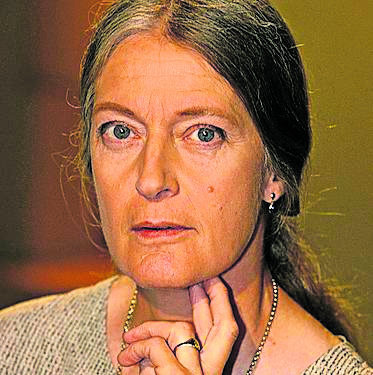
Gillian Tindall

Historian and novelist whose works traversing fiction, architecture and biography showed how the past influences the present
Gillian Tindall

The unfolding of history from mundane phenomena — a modest house or street, a surviving cache of letters — was the distinctive gift of the historian and novelist Gillian Tindall, illuminating ordinary lives with scholarly rigour and sympathetic imagination. In addition to these pioneering works of “micro-history”, her oeuvre ranged from novels, short stories and essays to biography, radio plays and even a study of Bombay’s history and architecture.

Born in London in 1938, Gillian Elizabeth Tindall was the daughter of Dennis Tindall, a medical publisher, and the novelist Ursula Orange. Her childhood was unhappy. In Three Houses, Many Lives, she described her hated boarding school, Manor House School in Limpsfield, Surrey. Visiting long afterwards, it still filled her with “a miasma of sickly dread”. Her mother committed suicide when she was 17, an act Tindall found hard to forgive, both for herself and for her devastated younger brother.

As a precocious teenager, she spent liberating months in Paris before reading English at Lady Margaret Hall, Oxford, graduating with a first-class honours degree. It was the acceptance for publication of her first novel, while she was still an undergraduate, that persuaded her to become a writer rather than a lecturer. As a historian her breakthrough came in 1977 with the publication of The Fields Beneath: The History of One London Village, an in-depth study of the district of Kentish Town in north London. Thirteen years earlier, she had moved there with her husband Richard Lansdown, a distinguished psychologist, and bought a two-storey house in one of its oldest terraces, which was to be their home for more than 60 years until her death.

The Fields Beneath encapsulates Tindall’s way of seeing urban landscape as a palimpsest. Its appearance, in her erudite and lucid revelation, had been shaped not only by Victorian development, by the railways and even the chances of war, but by older geographies of vanished waterways and drovers’ tracks: she called the area “disguised countryside”.

Another of Tindall’s abiding fascinations was France. Paris was the setting for an early novel, Fly away Home, which won the Somerset Maugham Award, and for a book haunted by her ancestors, Footprints in Paris: A Few Streets, a Few Lives. A later, remarkable biography, The Journey of Martin Nadaud (1999), traced the career of a 19th-century French stonemason from revolutionary to exile in England and his eventual return. Characteristically she had chosen to write not about a celebrated figure, but about the rise of a humble artisan from a rural backwater. After its publication she became a Chevalier of the Ordre des Arts et des Lettres.

In 1973 Tindall and her husband had bought a second house, not a typical holiday home but a village cottage in Chassignolles, in the heart of France. And soon afterwards, while visiting an empty house there, she came upon an abandoned sheaf of letters addressed by different suitors to an innkeeper’s daughter a century and a half earlier. Tindall’s book CĂ©lestine: Voices from a French Village, to which these letters gave birth, was one of her most successful: the evocation of a rural France on the brink of transformation.

Assiduous local research, a deep knowledge of French history and a gift for scrupulous reconstruction gave the work a vivid immediacy.

For many years Tindall and her husband amassed material and photographs of 1960s London, and she became a valued voice on the conservation committee of the London and Middlesex Archaeological Society. “Directly and indirectly,” ran a recent article in the journal of the Royal Institute of British Architects, her “book [The Fields Beneath] has helped forge a way of seeing cities and places that is integral to most practising architects’ education”.

Tindall’s study of a single Bankside house built in about 1710, A House by the Thames, delved back into its succession of varied occupants, wealthy and very poor. Her other books include a study of memory, partly personal, The Pulse Glass and the Beat of other Hearts, about the evocative power of leftover objects.

Her works were often concerned with the influence of the past on the present, and the complexity of memory.

The memory of Tindall herself evokes a woman of unswerving integrity. She was blunt in dispelling pretension and stupidity, but her friendships were loyal and lasting. She is survived by Richard, her husband of 62 years, and their son Harry, a television producer. Not least, in its conviction that the death of the past impoverishes the present, she bequeaths a body of work that bears the stamp of a unique mind and sensibility.

Gillian Tindall, historian and novelist, was born on May 4, 1938. She died on October 1, 2025, aged 87 


Sunday, October 12, 2025

DP25024 Social Media superceding Books V01 121025


The Sunday Times has today launched a campaign to Get Britain Reading after new data showed that people of all ages now read social media posts more often than books.

Among younger British adults, printed books have dropped out of the top three most popular reading formats, falling below subtitles and digital articles.

Decades of research shows that reading for fun can transform lives. It boosts children’s and adults’ mental health and has been found to be more important for a child’s cognitive development between the ages of 10 and 16 than their parents’ level of education.

Yet the proportion of children who never read for enjoyment is rising across every age bracket, according to the National Literacy Trust. One in five children aged 11 to 13 never pick up a book voluntarily and parents are reading less frequently to their children.

One in ten children (9.8 per cent) aged 5 to 18 surveyed by the National Literacy Trust do not have a book of their own.

Secondary school heads say many 11-year-olds arrive in Year 7 still in the early stages of learning to read. The problem affects up to 150,000 children a year in England. The crisis is also hitting our universities. This month it emerged that experts were teaching English literature undergraduates how to concentrate long enough to read lengthy novels. Academics said the students had grown up with phones and often felt intimidated.

With our Get Britain Reading campaign you can: 
● Donate to Bookbanks to put books in the hands of those most in need
● Volunteer to read in schools with Coram Beanstalk 
● Above all, take our pledge to read for pleasure for at least ten minutes a day for the next six weeks

The leading figures supporting our campaign include Chimamanda Ngozi Adichie, Salman Rushdie, Jamie Oliver, Michael Morpurgo, JK Rowling, Nick Cave, David Nicholls, Jacqueline Wilson, Katherine Rundell, Philip Pullman, Simon Armitage, Robert Harris, Ian McEwan, Anne Fine, Marian Keyes, Quentin Blake and Dolly Alderton.

The scale of the challenge has prompted the government to declare 2026 the National Year of Reading. Bridget Phillipson, the education secretary, said: “It’s incredibly important that children have the chance to read for pleasure, develop a love of reading, because those habits that you build up as a child stay with you for the rest of your life.”

British adults across all age categories are now more likely to read social media posts than any other reading format, according to a report funded by Arts Council England. The survey of 4,000 UK adults by The Reading Agency, a charity, found that subtitles were the second most commonly read format for under- 35s. Print books featured in the top three for those aged 35 and over, as well as either digital articles or print media.

Adults spend eight full days and nights a year reading social media posts, compared with six days reading a book. They were far more likely to “very much enjoy” reading print books than social media (45 per cent versus 23 per cent).

The benefits of taking time out to read in any format are stark. The report found that those who read regularly are 45 per cent more likely to report sleeping well, 58 per cent more likely to report feeling generally happy, 35 per cent more likely to say they do not feel lonely and 32 per cent more likely to say they do not feel anxious or depressed, than non-readers.

We are asking for donations from readers to Bookbanks, a charity that gives away books at food banks. Emily Rhodes,its founder, said: “We see a real hunger for books. Books can take readers on many extraordinary journeys — one of these could well be a journey out of poverty. We are so grateful to The Sunday Times and its readers for helping us raise the funds to reach more of the 2.4 million people accessing food banks in the UK.”

The demise of regular reading among adults is affecting how much parents read to their children. A report by HarperCollins found less than half (41 per cent) of under fives are read to frequently, a steep fall from 64 per cent in 2012. Parents also read less to their sons than their daughters. Only 29 per cent of boys under three are read to every day or nearly every day, compared with 44 per cent of girls.

Coram Beanstalk needs readers’ help to pass on their love of reading to children by volunteering across Britain’s schools. Amy Lewis, head of Coram Beanstalk, said that all children deserved someone to help them build on the skills they learn in school so they can discover the “immersive” enjoyment of books.

Laura Trott, shadow education secretary, said: “On my way to work every morning, it’s hard not to notice adults and children sitting side by side, not talking, not reading, just heads down, faces lit by phone screens. We’re losing the ability to concentrate, to think deeply, and the joy of getting lost in another world ... That’s why The Sunday Times’ Get Britain Reading campaign is so important, and why I’ve pushed so hard to get smartphones out of schools.”

Wednesday, October 1, 2025

DP25023 Founder of Spotify taking a back seat. V01 011025


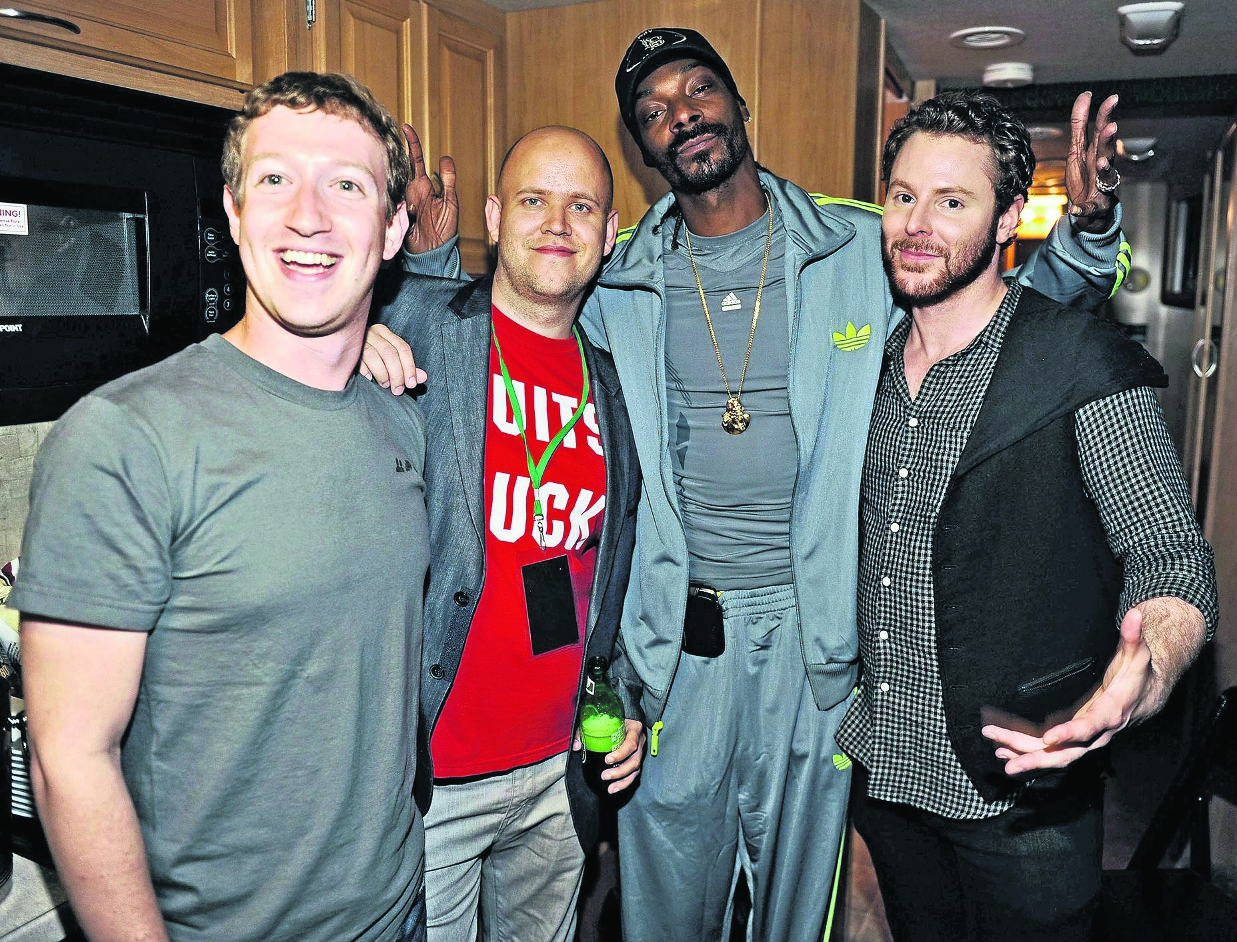
Facebook founder Mark Zuckerberg with Spotify’s Daniel Ek, rapper Snoop Dogg and Napster co-founder Sean Parker

Daniel Ek, the founder of Spotify, is stepping back from day-to-day running of the streaming giant to focus on longterm strategy and pursue his ambition to create more “super-companies”.

Ek, 42, will move to the role of executive chairman in January, with Spotify executives Gustav Soderstrom and Alex Norstrom jointly taking over the chief executive position.

In a memo to employees, Ek said: “Why now? Because Alex and Gustav have clearly demonstrated that, with the support of this remarkable team, they are ready to lead Spotify as co- CEOs. And because you all have stepped up, I can confidently step back from the day-to-day.” He said he intended to “help create more of these super-companies, ones that are developing new technologies to tackle some of the biggest challenges of our time”.

Spotify Technology’s shares, which have gained 63 per cent this year, closed down $30.69, or 4.2 per cent, at $697.78 in New York last night.

Ek was still in his early twenties when he founded Spotify in Sweden in 2006. He has built it into a streaming giant with a market valuation of $144 billion.

As executive chairman, Ek will focus on capital allocation and long-term strategy in what the company called a European-style chairman role. He has a net worth of $9.8 billion, according to the Bloomberg Billionaires Index.

Spotify, which has nearly 700 million monthly users, receives a monthly subscription fee for ad-free listening from half its customers. It reported its first annual profit in 2024 after a series of price increases and cost-cutting efforts.

Global revenue from recorded music rose 4.8 per cent to $29.6 billion in 2024. Streaming exceeded $20 billion for the first time and subscription streaming accounted for more than half of it, according to IFPI’s Global Music Report.

Soderstrom, currently chief product and technology officer, oversees global tech strategy and product development, while Norstrom, as chief business officer, manages subscriber and advertising businesses along with music, podcast and audiobook operations.

They will report to Ek, who also serves on the board.

DP25022 New eBook Platform. V01 011025

 Ebook rival to Amazon 

Amazon’s ebook monopoly is being challenged by an online bookshop that allows brick and mortar shops to make money from the digital books it sells. Bookshop.org’s ebook platform launches today with more than a million titles and lets buyers nominate a bookshop to receive a cut of sales. Amazon is refusing to allow the ebooks onto its Kindles.