Welcome to our most expensive sales of April, May, and June 2025. Highlights include a pristine first edition of Steinbeck's "The Grapes of Wrath," Dali's surrealist "Alice in Wonderland," and a rare Brussels edition of "Don Quixote." This quarter's diverse offerings span from landmark Renaissance editions to defining works of modern literature.
Saturday, August 2, 2025


Wednesday, July 30, 2025
DP25003 Substack V01 310725
Substack reels in star investors as media rivals feel the pinch

Ian King
‘‘ Fortunes are shifting in the media sector. This month, Reach, publisher of the Mirror and Express, has set out changes to its sports reporting that are expected to result in 50 job losses, while the American magazine Fortune has announced a 10 per cent reduction in its global headcount, with the loss of several hundred jobs, including its entire editorial team in Europe.
Last month, TechCrunch, the respected US publication, said it was leaving the UK and Europe, and the month before, Business Insider cut more than a fifth of its editorial roles.
Yet money is flowing in to other parts of the media. Two weeks ago, the publishing platform Substack completed a $100 million series C funding round, taking its valuation to a reported $1.1 billion — up 70 per cent on the valuation achieved at its last full series B round in March 2021.
It was attention-grabbing not only for the valuation but also for those participating, which included Chernin Group, an investor in sports and media businesses founded by Peter Chernin, formerly president and chief operating officer of News Corporation, ultimate owner of The Times.
Other investors included Klutch Sports Group, a sports agency founded by Rich Paul, who is engaged to the singer Adele. Also investing was Jens Grede, who with his British wife Emma and the media personality Kim Kardashian founded Skims, the clothing brand.
So far, so glitzy, but on board too were BOND, the global technology investment firm that has previously backed the likes of Uber and Airbnb, and Andreessen Horowitz, one of Silicon Valley’s biggest venture capital firms.
The involvement of the latter, which led Substack’s series A funding round in July 2019, is probably the most significant because the platform is evolving into a rather different business to the one that Andreessen Horowitz first backed.
Then, Substack’s founders — Chris Best, Jairaj Sethi and Hamish McKenzie — talked about offering an alternative to advertising-funded online media platforms. They argued that because the latter depended on engagement, they had become overwhelmed with spam and toxicity.
As McKenzie told Business Insider in August 2019: “Ad models break everyone’s brains.”
Now, though, Substack seems to be preparing to embrace advertising — something first signalled by McKenzie in March last year when he told the online trade magazine Digiday: “For us, advertising is an interesting business. Maybe some way off in the distant future.”
That looks to be what is exciting some investors.
Mike Kerns, co-founder of Chernin Group, told The New York Times earlier this month: “Their creators have told them that they want Substack to support advertising. We think it is a massive opportunity to launch a native form of advertising within the Substack ecosystem at some point.”
Such a move may also be taken as evidence that Substack’s founders are becoming pragmatic to keep the platform’s content creators happy.
That task has been made harder by the political backdrop in the US, with several big tech players previously critical of President Trump, most notably Meta’s Mark Zuckerberg, subsequently cosying up to the president. Substack’s founders have been accused in some quarters of similar behaviour.
Beehiiv, a rival newsletter platform, told Digiday in April this year that 3,000 former Substack creators had joined it during the previous 12 months — many of them apparently unhappy at “politically extreme” voices on the platform.
It is a challenge for Substack’s founders, who until now have pushed back against pressure to become a social media platform, a stance they reiterated in a blog posted to accompany the fundraising: “The model is working — across writing, audio, video and communities — and this funding lets us go further.
“We aim to prove that a media app can be fun and rewarding without melting your brain. An escape from the doom scroll, and a place to take back your mind.”
That was an apparent jibe at Elon Musk, who, in April 2023, offered to buy Substack shortly after completing his acquisition of Twitter (now X) in the previous year.
Yet the possibility of an embrace of ads is not the only factor generating investor interest in Substack.
Another is how artificial intelligence is changing the nature of online search. AI platforms are increasingly sending more traffic to the websites of established publishers — although not, unfortunately, to the latter’s benefit. A US study published last week by the Pew Research Center, based on nearly 69,000 searches, found that where an AI Overview was provided, Google users clicked on links to other sites 8 percent of the time. They did so 15 percent of the time when no AI Overview was provided.
This means the old search engine optimisation approach to driving traffic — one taken by many websites for the past decade or more — is fast becoming irrelevant.
Carly Steven, director of SEO and editorial e-commerce at Mail Online, said in May that when a Google AI Overview appeared for a search query, the Mail’s average clickthrough rate was 56.1 percent lower on desktop computers and 48.2 percent lower on mobile.
The change may, though, provide an opportunity for those publishers — and platforms such as Substack — that have built deeper relationships with their audiences through newsletters or subscriptions. It is likely that Andreessen Horowitz had this in mind with its latest investment.
Meanwhile, for other parts of the media, bad news keeps coming. On Monday, the tech news brand Digital Frontier closed after a year in business.
Ian King is a former Business & City Editor of The Times.
Saturday, July 26, 2025
DP25002 Penguin Books Publisher V01 270725
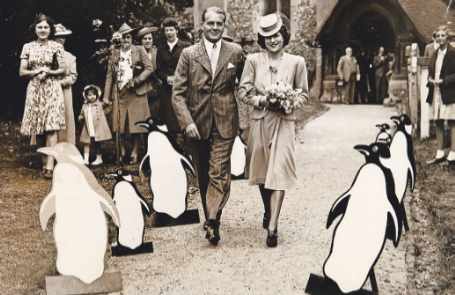
Allen Lane’s wedding and his penguin guard of honour
In 1934 the young publisher Allen Lane was in Exeter, waiting for a train. He had been visiting his friend Agatha Christie and was in search of a good book. There was nothing suitable in the station — only trashy novels with lurid covers. He had an idea: people should have access to good quality books in paperback form, costing no more than a packet of cigarettes. His goal, he later said, was “missionary and mercenary”.
The result of that idea, Penguin Books, was launched the following year and is now the most famous publishing house in the world. Its authors include George Orwell, Virginia Woolf, Zadie Smith, Marian Keyes and Philip Pullman. The global brand, Penguin Random House, recorded revenues of €4.9 billion last year, 10 per cent of which came from British sales.
It has been a remarkable success story, and Penguin has gone all out for its 90th birthday, holding a Nothing Like a Book festival and an exhibition at No 11 Downing Street. A birthday bash at the Design Museum in London welcomed the biggest names in books.
But the celebrations may have been dampened. On July 5 The Observer ran an investigation into The Salt Path by Raynor Winn, which was published in 2018 by the Penguin imprint Michael Joseph. Key elements of the story — how Winn and her husband, Moth, became homeless and the severity of Moth’s disease — appeared to have been fabricated or exaggerated. Penguin responded to say that it “undertook all the necessary due diligence” and that the book’s contract included “an author warranty about factual accuracy” — in other words, that the blame lay with Winn. This month the publisher announced that it had postponed the October publication of Winn’s next book, On Winter Hill.
I asked Tom Weldon, the chief executive offcer of Penguin Random House UK since 2011, if there was anything more the publisher could have done. “We publish 1,500 books each year, and it’s literally just a handful which might spark debate,” he said. “It’s something we’ve successfully navigated across our 90-year history and is part and parcel of the publishing industry: books will, and should, drive discussion.
Founder Allen Lane thought penguins had ‘a certain dignified flippancy’
“The conversation around memoirs is not new,” he added. “They are often navigating complex emotional terrain, and the publishing process is based upon a mutual relationship of trust between the author and editor. In this case I am completely confident that our editorial and legal processes were — and remain — entirely appropriate and robust.” It is not the first time Penguin has had to deal with scandal, from fatwas to obscenity trials. I looked back to its beginnings to find the flashpoints that made it a globally recognised name.
My journey began not in the company’s shiny Vauxhall offces, but at Bristol University, the home of Penguin’s offcial archives. The head of brand, Zainab Juma, showed me the first ten sixpenny paperbacks, with their signature orange covers and cartoon penguins. (Lane chose the bird because he felt they had “a certain dignified flippancy”.) These first books ranged from Ernest Hemingway’s A Farewell to Arms to Agatha Christie’s Murder on the Links.
Penguin’s early days were uncertain. The company struggled with its small profit margins — the only offce it could afford was the damp crypt under Holy Trinity Church, Marylebone. Books were taken up in a lift that used to carry coffns, and the team used a communal lavatory in the form of a tin bucket.
The Second World War made Penguin a trusted British brand (it published guides to aircraft recognition and fruit growing, and started an armed forces book club), but it was a scandal that made it a global success.
Is Lady Chatterley’s Lover a book you want your servants to read, the jury was asked
In its original form, Lady Chatterley’s Lover, DH Lawrence’s novel about a married woman who has an affair with her husband’s gamekeeper, was full of foul language, sex and shocking views on class, love and marriage. Another publisher released an expurgated version of the book, but Lane believed the British public deserved the whole thing. In 1960 he published a “complete and unexpurgated” version.
There was only one problem — the year before, the Obscene Publications Act had been passed, which made publishing something this filthy illegal. Copies hadn’t even hit the shelves when Lane was called back from his holiday in Malaga with the alarming telegram “LEGAL ACTION IMMINENT STOP ADVISE YOUR IMMEDIATE RETURN”.
Penguin assembled critics, bookselling magnates and cultural commentators, hoping that they could prove that the book deserved to be published based on its literary merit. In his opening speech the prosecuting counsel Mervyn Griffth-Jones asked the jury: “Is it a book you would have lying around in your own house? Is it a book you would even wish your wife or your servants to read?” This changed the whole tone of the trial. It became about more than obscenity; it was about a ruling class who continued to patronise women and working-class people.
Penguin’s victory was “a rocket fuel moment”, Juma says. Vast queues formed outside bookshops. It took multiple printers to meet the initial demand for 300,000 copies — and Lady Chatterley’s Lover went on to sell three million copies in total.
Even after Lane’s death in 1970, Penguin has defended books it believes deserve to be read. To this day the publication in 1988 of Salman Rushdie’s The Satanic Verses divides audiences. It prompted large-scale protests, a fatwa against Rushdie and Penguin and, in 2022, an almost fatal attack on the author.
Would such a book be printed today? “What we encourage our editors and publishers to do today is to have very robust, honest, open conversations about what books they’re going to publish,” Weldon says. “If they are convinced there is an editorial justification, they should stick to their guns. And yeah, I genuinely think we still do that.” He points to a range of authors from Greta Thunberg to Jordan Peterson as proof.
Others might disagree. Some new publishing houses claim to publish the books that big companies won’t touch. Swift Press, an independent press founded in 2020 by Mark Richards and Diana Broccardo, published Richard Reeves’s Of Boys and Men in 2023.
Richards said that the book — described by the Sunday Times reviewer as “one of the most important non-fiction books of the year” — had been turned down by others, worried that its take on the problems that men face would be considered offensive. Did Penguin miss a trick — and what else is it missing? The basement in Bristol is a treasure trove of Penguin books, many from Lane’s personal collection. Scouring the aisles, I found it remarkable how many I recognised — not just ones I’d read at university, but the Roald Dahl editions I loved as a child, cookbooks from my grandmother’s kitchen and the copies of Shakespeare my greataunt passed down to me. Like the royal Christmas speech, Penguin has become such a feature of British life you almost forget it’s there.
Will it still be here in another 90 years’ time? This is the age of distraction, where attention spans are decreasing and people are turning to social media for entertainment. The National Literacy Trust has found that the number of children and young people who say they enjoy reading has fallen by 36 per cent.
I put this to Weldon, who nods.
“We have a special responsibility to try to address some of these structural challenges. We’ve led some really impactful campaigns to try and address this, not least Libraries for Primaries, where we’ve put libraries back into primary schools in conjunction with the National Literacy Trust. And this goes back to Allen Lane, because he said that reading shouldn’t be for the privileged few.”
Arguably the future’s greatest threat, though, is AI. Technology companies are using published books to train AI models without authors’ consent and Penguin is fighting for the proper enforcement of copyright laws intended to protect human creativity.
“We need to win that battle with government,” Weldon says. But he isn’t entirely pessimistic. “If used responsibly, AI could be an enabler, and it could elevate human creativity if it reduces some of the repetitive tasks involved in our business.”
As AI becomes an ever-more invasive feature of our lives, people want to know the books they read are true. Will the Salt Path controversy erode trust in the brand? “Penguin’s reputation as a publisher has not been built overnight,” Weldon says. “Instead, we have gained the trust of readers through the quality books we put into the world, which have brought joy, new ideas and learning to many. In a world where anyone can publish anything online, books remain essential as authoritative, expert and humancrafted content.”
It would be easy to look at Penguin’s challenges — the Salt Path fallout, addictive algorithms, artificial authors — and fear for its future. But Weldon is confident. “So many people predicted the death of the book 20 years ago. And actually we’re in a pretty good place, particularly compared with newspapers and magazines … So do I think it’s going to be the death of the book? Absolutely not. I think human creativity will always flourish
Thursday, July 10, 2025
DP25001 Thames and Hudson Publisher V01 100725
Thomas Neurath
Publisher who was shocked to be elevated to lead the family firm before rejecting Hitler’s propagandist despite her fine work
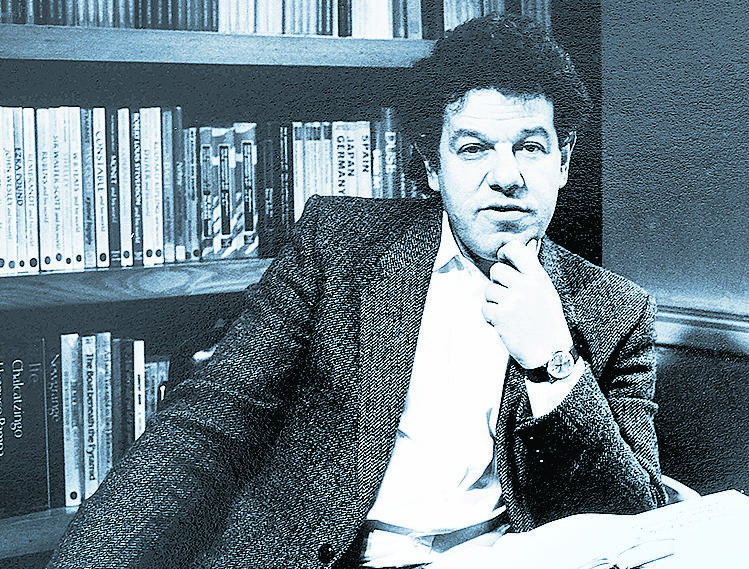
Neurath during the 1980s. His office overlooked the back of the British Museum.
Thomas Neurath did not expect to be running Thames & Hudson, the family publishing firm, in his mid-twenties until his father Walter Neurath suddenly died in 1967. Neurath was already working there as an editor but his elevation only became visible when the sales director physically marched him into his father’s office, sat him down in the empty chair and said: “You’re in charge now.”
In a later interview, he admitted: “I can’t remember ever wanting to be a publisher, and then one day I was.”
His independent streak manifested itself early on after he left Charterhouse School. He went to Paris and ended up living at the “Beat Hotel” in the Latin Quarter, then famous as the temporary home of leading countercultural American poets and writers such as Allen Ginsberg and William S Burroughs. Conditions were spartan. Hot water was provided only three times a week and the sheets changed on a monthly basis.
After family pressure, he returned to enrol at St John’s College, Cambridge, to study anthropology and archaeology. But after the glamour of his earlier adventures, he was off again to Vienna and Jerusalem, his father allegedly hiring private detectives to track him down. This time he accepted a position in 1961 as an editor at Thames & Hudson, remaining with the firm for the next 60 years as managing director and then chairman.
Building on the solid foundations of his father Walter, who jointly founded the company in 1949 with Eva Feuchtwang (later his second wife), it became the most influential and respected illustrated book publisher worldwide. As a homage to its cultural and commercial origins, it was named after the rivers of London and New York, though for several years correspondence would arrive addressed to Mr Thames and Mr Hudson.
The company has always been privately owned, Thomas’s sister Constance becoming art director in 1967 and his daughters Johanna and Susanna actively involved and still on the board. His stepmother Eva remained with the company as chairman — her preferred title — until her death in 1999. She arrived at the offices in her chauffeur-driven Rolls Royce, which also accompanied her to the annual Frankfurt Book Fair as she was convinced that it enhanced the reputation of the firm to see her driven from her hotel suite to the Book Fair.
Thames & Hudson expanded considerably under Neurath’s control but always through internal growth rather than mergers or acquisitions. On several occasions he turned down such offers, remarking: “When you buy a company, everything that is brilliant about it can fall through your fingers like sand.”
While remaining focused on the publication of art books and museum catalogues, he broadened its perspective to include photography, fashion, religion and even children’s books. In 1961, a large-format series started called Great Civilisations with renowned historians such as John Julius Norwich, Hugh Trevor-Roper and Asa Briggs.
One of the most profitable ventures was the World of Art paperback series, published in 16 languages and now running into several hundred titles ranging from Old Masters to Art and Climate Change, boasting total sales upwards of 15 million copies. Under Neurath Thames & Hudson expanded from its original base of offices in London and then New York to include branches in Paris, Melbourne, Hong Kong and Singapore.
Given the high cost of publishing illustrated books, it was essential to have titles with international appeal to do deals with other publishers and also sell foreign rights in other languages. Even in his final days, after retiring as chairman four years earlier, he was still reading proofs of new books for publication in his private office just north of Ladbroke Grove and Notting Hill.
Thomas Neurath was born in 1940 in Upper Boddington, Northamptonshire, where his Jewish parents stayed with the family of Captain David Margesson MP, then the chief whip in Churchill’s government and, by December 1940, secretary of state for war. Margesson’s wife had sponsored Walter Neurath and his wife, Marianne, who escaped from Vienna in 1938, where they were in hiding after appearing on a Gestapo hit list for anti-Nazi publishing activities.
He continued his profession with Wolfgang Foges, another Jewish refugee from Vienna, designing and producing the King Penguin series and then Britain in Pictures, which included authors such as George Orwell, John Betjeman and Rose Macaulay.
Thames & Hudson was launched in 1949 with the intention of being a “museum without walls”, which has remained the mission statement of the company. In an interview in The Times celebrating Thames & Hudson’s 60th anniversary in 2009, Neurath recalled that he grew up in “a terrifically Viennese household”, saying: “We spoke German when I was a boy. My grandparents, who had also come out of Vienna in 1938, lived in Hampstead, and they were all members of the Anglo- Austrian Society. Walter was on the fringes of the Fabian Society and all these interesting people were brought together by anti-Hitler sentiments.”
After Walter’s death, Neurath expanded the variety of titles published. In an interview in Paris in 2011, he recounted: “In my father’s view, only painting, architecture and sculpture counted as art in their own right … He thought of photography as lacking in seriousness and fashion as frivolous.”
Neurath published some of the greatest contemporary photographers, including Henri Cartier-Bresson, Cecil Beaton and David Bailey. Not all books were considered suitable, including a stunning volume by Leni Riefenstahl of the Nuba tribe in Southern Sudan.
While Neurath was impressed with the content, he drew a line at publishing anything by Riefenstahl, who had been an admirer of Adolf Hitler. Over lunch at the White Tower in Bloomsbury, Neurath asked her what sort of man Hitler was and was taken aback by her unashamed reply: “He was the most exceptional and inspiring man I ever knew … Of course, he had the great misfortune to be in power at that particular time. I have never met anyone who had such a strong aura of energy emanating from him.”
He met his wife Gun Thor, a jewellery designer, while hitchhiking in the Peloponnese in the early Sixties and later they would regularly spend the summer months there. They married in 1962 and she survives him along with their two daughters.
Neurath remained as managing director until 2005, when he retired and became chairman until 2021. He was highly cultured, with a keen interest in classical music, history and literature with a wide circle of friends, including many distinguished central European refugees who fled Nazi Germany. He also maintained an eclectic group of friends from the music industry, including Andrew King and Peter Jenner, early managers of Pink Floyd. Tim Page, the Vietnam war photographer who featured in Francis Ford Coppola’s Apocalypse Now, was also a close friend.
A voracious reader, he was fluent in German, French and Italian and could read Latin and ancient Greek. The last book he was reading before his death was the new edition of Franz Kafka’s diaries. One of his regrets was not to being able to read or speak Russian.
He maintained a company flat on the Left Bank of Paris and kept a cottage in the Cotswolds near Cirencester. His house in Highgate was so laden with books that carpenters had to be called in to reinforce the joists to prevent it from moving off its foundations.
Thomas Neurath, publisher, was born on October 7, 1940. He died on June 13, 2025, aged 84.
Saturday, October 19, 2024
DP24012 Regional Newspapers V01 191024
With the steady decline in Regional Newspapers, alongside their National counterparts, I have been interested to see what will replace them in the marketplace. There is definitely a demand for local news with social media being too unstructured and unmoderated to satisfy this need. The production of more structured content delivered in an Digital Format (eg PDF) or Website or Printed Paper incur writing and production costs. Unless financed on a fully volunteer or donation basis advertising revenue is needed to balance the books since in the marketplace customers will neither pay or subscribe for such a local news service.
The Regional Newspaper sector has
moved towards the low or poor content advertisement loaded “freebie” concept. These
are not succeeding because analysis has shown that the pages containing content
rather than advertising have to exceed at least 20% of the publication to
retain any sort of reader engagement. With the reader interest known to increase
as the content increases and the advertising reduces. So it is balance between
what gets printed on the page or displayed on the screen between content and
advertising. Content retains readership whilst advertising generates revenue
and inevitably survival.
So it was whilst I was walking
around Pershore, Worcestershire high street that I picked up yesterday a printed copy of the “Pershore
Times” (October 2024). Full colour printed on high quality
white paper with a large size of 22.5 cm (Width) and 32.0 cm (Depth) this was
an impressive free monthly Newspaper. What was most impressive was the amount
of interesting written content provided by a number of different enthusiastic
writers.
I thought this article below by Emily Papirnik was worthy
of inclusion to illustrate the point I am making.
In todays world many of us
find ourselves worrying about how others perceive us. This constant pressure to
fit in with peers, communities and environments can push us to change aspects
of our identity. In fact, some may find that they alter themselves so much in an
attempt to belong that they lose sight of who they truly are.
Adapting to our environment.
This phenomenon is particularly common in personal
and professional environments. Some people shift their personality or behaviour to manage work situations with more ease or efficiency, becoming
someone else just to survive in a particular role. At home, it
is not
uncommon for individuals to prioritise others’ needs over their own, playing the caretaker or peacemaker to ensure harmony. While these adaptations may serve short-term goals, they can lead to a deeper sense of disconnection from our true selves over time.
The chameleon effect.
We all do it – change our behavior, the way we present ourselves, or even our physical appearance
to blend in. This can reach a point where the question arises: ‘Who am I really?’ Many of us encounter this realisation when a significant life transition occurs. It could be a young adult leaving school or a parent experiencing an empty nest after their children
move out. During these shifts, individuals may feel lost, struggling to remember what they actually enjoy, or how they prefer to spend their time. In
these moments it’s common for people to revert to familiar past activities, not because they genuinely enjoy them, but because they were once shared with someone
else.
A scary yet liberating moment.
Such realisations can be scary. It’s the moment you acknowledge that you have neglected your own needs, wants and even passions. You may find yourself asking ‘What do I enjoy doing? – especially when no one else’s preferences or needs are involved. It’s not just a frightening moment – it’s a freeing one.
This time of self-discovery offers an opportunity to explore new avenues
of joy and curiosity, unencumbered by outside expectations. The important question
then becomes: ‘What fives you joy?’
Rediscovering Joy
This was the question I posed to one of my clients recently. At first, they had no answer. They began reflecting
on activities from their past but quickly realised they didn’t truly enjoy many of those things. This discovery marked the beginning of an exciting
journey for them, a process of investigation and anticipation, looking
forward to new possibilities.
Rather than feeling sad about the time lost, this is a moment to be curious.
What will you uncover when you look within? Ask others what they enjoy, experiment with new hobbies or pastimes and allow yourself
the freedom to grow into your own happiness. Rediscover what makes you you, and start living for yourself
once again.
There were a number of other
articles equalling this level of quality writing.
So significantly behind
this publication was a 4th Generation Local Printer who had obviously
embraced both technology and authorship. It works because it is truly “local”
in content with them publishing three more very specifically local newspapers.
Being monthly it allows for better time management and organisation in the
assembly of good content. It looks like they have retained regular local
writers to generate this content for free or by allowing them to delicately advertise
their product or service in the article itself or using the article footnote.
Looking at the file naming it looks like they are lithographically printed
rather than the more expensive digital printing. It is also built upon
consistently paid up regular local business advertising revenue. It appears
that a lot of the distribution is from stands sited in the local retailers. The
clever use of “reasons to keep” articles from the likes of churches, history
societies, local interest groups etc guarantee it has a shelf life rather than
immediately going in the bin.
This is an exceedingly
well thought through local business owned Regional Newspaper which looks to have on the face of it a long term future.
Now the big question is
how can something as effective as this be implemented right across the country
and not just in a few Worcestershire Market Towns and Villages.
Use this link to go to
the Pershore Times website where you can access this months Newspaper and view
previous archived copies. Even the design of the website is a masterpiece in
simplicity.
Details in the photo of
the Publishing Company. Hughes & Company and the genius Proprietor and
Editor Alan Hughes.


Subscribe to:
Posts (Atom)