Sunday, January 25, 2026

DP26004 Publishers Association - AI V01 250126

 The Publishers Association white paper "People Plus Machines: The Role of Artificial Intelligence in Publishing" (commissioned from Frontier Economics) is a seminal industry document. It moves away from the "AI vs. Humans" narrative and instead focuses on how AI serves as a tool for efficiency, protection, and growth.

The report is structured into several functional "thematic pillars" rather than traditional narrative chapters. Below is a detailed description of these core sections.

Section 1: Defining AI for the Publishing Sector

This opening section establishes a shared vocabulary. It moves beyond the "sci-fi" tropes of AI and defines the technology specifically through its application in the book and journal industries. It categorizes AI into "sensing, comprehending, acting, and learning," but narrows the focus to Natural Language Processing (NLP) and Machine Learning (ML).

The report explains that for publishers, AI isn't just one tool but a "taxonomy of technologies." This section emphasizes that the industry is at a "watershed moment." It provides a baseline understanding of how data—the raw material of publishing—is transformed into "mineable" formats. The focus here is on the transition from traditional digitization to "intelligent data," where the machines can actually understand the relationship between different texts, rather than just storing them as static images or PDFs.

Section 2: Content Acquisition and Development

This section addresses the "top of the funnel"—how publishers decide what to publish. It explores how AI is used to identify trends before they hit the mainstream. Large publishers are increasingly using algorithms to scan social media, self-publishing platforms, and academic archives to "extract" potential bestsellers or breakthrough research topics.

Beyond just finding new authors, this chapter describes the use of AI in peer review and content assessment. For academic publishers, AI tools can automatically detect plagiarism, check the validity of scientific citations, and even suggest appropriate reviewers for a manuscript. In consumer publishing, it discusses "predictive analytics," where AI helps editors understand which genres are growing and which are saturated, effectively acting as a data-driven "editorial assistant" that mitigates the financial risk of signing a new book.

Section 3: The Production and Editorial Value Chain

This is the most practical section of the report, detailing how AI "supercharges" the labor-intensive middle of the publishing process. It breaks down the shift from manual copy-editing to augmented editorial workflows. Tools are described that not only check grammar but also "paraphrase" for readability, automate layout and typesetting, and handle metadata tagging.

Metadata is a major focus here; the report explains that AI can automatically generate keywords and descriptions for books, making them much more "discoverable" in the digital commons of Amazon or Google. This section also highlights the rise of synthetic narration for audiobooks, noting how AI can produce audio versions of "backlist" titles that were previously too expensive to record with human voice actors. The central theme here is efficiency: freeing human editors from "routine research tasks" so they can focus on high-level creative collaboration with authors.

Section 4: Marketing, Sales, and Reader Engagement

This section focuses on the relationship between the book and the reader. It describes how AI enables "hyper-personalization." Instead of broad marketing campaigns, publishers use AI to analyze reader behavior—tracking not just what people buy, but what they "skim, skip, or highlight" in their e-readers.

The report details how this data loop allows for adaptive learning platforms in the education sector, where textbooks literally change their difficulty level based on a student's performance. In the consumer space, it looks at how AI-driven chatbots and recommendation engines are replacing traditional "hand-selling" in bookstores. The goal described is a "tighter link between audience needs and publishing output," ensuring that the right book reaches the right reader at exactly the right time through algorithmic precision.

Section 5: Rights, Intellectual Property, and Ethics

The final major section tackles the "thorny" issues of the AI era. It explores the dual nature of AI in Intellectual Property (IP): how AI can be used to protect IP (by scanning the web for pirated copies or copyright infringements) and how AI poses a threat to IP (by being trained on copyrighted works without permission).

The report advocates for a "clear legal framework" where human creativity and machine innovation are seen as complementary. It touches on the ethics of "transparency," arguing that publishers must be open about when and how AI is used in the creation of a book. This section concludes with the "People Plus Machines" philosophy: that while AI can mimic tone and structure, the "narrative arc" and the "soul" of a best-seller still require a human heart. It positions the human role not as a worker to be replaced, but as a "curator and validator" of machine-generated outputs.

DP26003 LLMs and the Original Author Copyright V01 250126

 In "How AI Ate the World", Chris Stokel-Walker addresses the subject of Large Language Models (LLMs) and their relationship with authors' works—specifically the phenomenon of machines "extracting" or replicating copyrighted material across languages—through the lens of copyright, training data, and the loss of human agency.  

While the book covers many aspects of AI, the specific subject of LLMs extracting or "remixing" original works into translated versions can be summarized through these three key themes explored by Stokel-Walker:

1. The "Ingestion" of the Digital Commons

Stokel-Walker describes how LLMs were built by scraping massive amounts of text from the internet and digitized libraries (the "Shadow Libraries").

The Extraction Process: He explains that AI doesn't just "read" books; it deconstructs them into mathematical vectors. This allows the AI to "extract" the style, plot, and even specific phrasing of an author and reproduce it in any language the model has been trained on.

The Author's Loss: For an author, this means their work is being used to create "synthetic competitors"—translated versions of their own ideas that they did not authorize and for which they receive no royalties.

2. Machine Translation as a "Double-Edged Sword"

The book traces the history of translation from Cold War clunky machines to modern LLMs.  

The Benefit: AI allows a book to be translated into dozens of languages instantly, potentially opening up global markets for indie authors.  

The Extraction Issue: Stokel-Walker highlights the "flattening" of language. When an AI extracts a work to translate it, it often misses the cultural nuance, sarcasm, and "soul" of the original author. It creates a "hollowed-out" copy that can flood markets, devaluing the original human-translated work.  

3. The Legal "Enclosure" of Literature

Stokel-Walker discusses the legal battles (such as those involving the Authors Guild) where writers are fighting back against their work being used as "training fuel."

Copyright Infringement: The book explores the argument that if an AI can "extract" enough of an author's unique voice to produce a translated sequel or a similar book, it has effectively stolen the "Code" of that person's creativity.

Derivative Works: He raises the concern that these AI-generated translations are technically "derivative works." In traditional publishing, an author owns the translation rights; in the "AI-eaten" world, those rights are being bypassed by users who use LLMs to bypass the traditional gatekeepers.

The "Content Crisis"

The core of Stokel-Walker's argument is that we are moving toward a "Content Crisis" where the sheer volume of AI-extracted and translated works will make it impossible for human authors to be discovered. He warns that if we allow LLMs to freely extract and remix the digital commons of literature, we risk a future where "new" books are just translated mashups of everything that came before them.


DP26002 Books on AI Publishing V01 250126

 Books focusing specifically on the impact of AI on the publishing industry range from technical guides for authors to deep philosophical investigations into how algorithms are reshaping the written word.

Here are the most relevant titles:

Industry-Specific Guides

The AI Revolution in Book Publishing by Thad McIlroy (2024, revised 2025): This is considered the definitive text for industry professionals. It covers how AI affects the entire "publishing value chain," from how manuscripts are acquired to automated marketing and the production of AI-narrated audiobooks.

The Coming Wave: Technology, Power, and the Twenty-first Century's Greatest Dilemma by Mustafa Suleyman and Michael Bhaskar (2023): While this book covers AI broadly, it is co-authored by Michael Bhaskar, a noted writer and publisher. It contains significant insights into how "hyper-abundance" of content will disrupt traditional publishing gatekeepers.

The Impact on Writing & Creativity

The Creativity Code: How AI is Learning to Write, Paint and Think by Marcus du Sautoy (2020): This book explores the fundamental question of whether AI can truly be creative. It examines the impact on literature and whether a machine can ever replicate the "spark" required to write a prize-winning novel.

How AI Ate the World by Chris Stokel-Walker (2024): This book focuses heavily on the "content crisis"—how LLMs (Large Language Models) are training on human-written books and then generating billions of words that threaten to drown out human authors in digital marketplaces.

Critical & Ethical Perspectives

Supremacy: AI, ChatGPT and the Race that Will Change the World by Parmy Olson (2024): Winner of the FT Business Book of the Year, this tracks the corporate war between OpenAI and Google. It is essential for understanding the "Enclosure" of the digital commons and how the data used for publishing is being centralized by big tech.

Code Dependent: Living in the Shadow of AI by Madhumita Murgia (2024): While we discussed its chapters earlier, this book is vital for publishing because it examines the human labor behind AI. It looks at the "data labelers"—the people paid pennies to clean and categorize the very text that AI then uses to "write" its own content.

Future Scenarios & Reports

"People Plus Machines: The Role of AI in Publishing": While technically a white paper by the Publishers Association, it is often cited alongside these books as the primary roadmap for how the UK and US publishing sectors are integrating AI into editorial workflows.

Sunday, January 4, 2026

DP26001 Sunday Times Book Critic - John Carey (RIP) V01 040126

 Three reviews that show how John Carey’s wit opened a new critical chapter

Biting insights flow through these pieces by the chief literary critic of The Sunday Times who died last month

Shakespeare’s Wife Germaine Greer, 2007
It is impossible to think of two minds more different than Germaine Greer’s and Shakespeare’s. The leading quality of Greer’s mind is opinionatedness, whereas Shakespeare, so far as we can tell, had no opinions. He vanished into his plays, and trying to retrieve what he thought on any subject is like harvesting shadows.

This is frustrating for Greer, since her aim in her new book is to pin down Shakespeare’s opinion about marriage, specifically his own. Only the barest facts are known for certain. When he married Ann Hathaway, a local farmer’s daughter, in 1582, he was 18, she was 26 and three months pregnant.

Susanna, their first child, was born in May 1583, and twins, Judith and Hamnet, in February 1585.

Before or soon after that Shakespeare probably left Stratford, and by 1592 he was already well known as an actor and dramatist in London, where he spent most of his married life. When he made his will in March 1616, a month before his death, his wife was not mentioned at all in the first draft, and a redraft left her his secondbest bed.

Some scholars (most of them, Greer notes accusingly, male) have taken these facts to mean that Shakespeare was trapped into marriage by a designing older woman; that he was frogmarched to the altar by her family; that, like many women of her class, she was probably illiterate, and certainly unable to appreciate her husband’s greatness.

Greer is convinced that, on the contrary, Shakespeare wooed Ann, not vice versa; that she proved a good, true wife, enjoying her husband’s love and respect; and that she took a keen interest in his writing, and was quite possibly instrumental in getting the First Folio of his works printed after his death.

Since there is little or no evidence to support these claims, their furtherance calls for considerable ingenuity on Greer’s part. She suggests that The Comedy of Errors, with its moving depiction of wifely loyalty, reveals Shakespeare’s “attitude to marriage”, so he would be unlikely to have treated Ann in the way her denigrators allege. The weakness of such arguments is obvious — you might, with just as little cogency, select The Taming of the Shrew as showing Shakespeare’s attitude to marriage — so most of Greer’s book takes a different tack, and contends that Ann was a highly successful woman in her own right, so Shakespeare should have been proud of her, even if he was not, though he probably was.

Exactly what she was successful at is difficult to decide. Greer thinks she might have been a successful moneylender. The one surviving document that may give a clue to her business activities, if she had any, is the will of the Hathaway family’s shepherd, which says she owes him 40 shillings.

This does not sound like successful moneylending, but perhaps, Greer thinks, the shepherd entrusted the money to Ann’s safekeeping, which could mean she was a successful banker.

Alternatively, she might have been a farmer or a cheesemaker, a mercer or a haberdasher, a basket weaver or a lace maker or a stocking knitter.

Wherever Ann’s success lay, she made enough money, Greer thinks, to bring up her family without her husband’s help (though why he should not have helped her if she enjoyed his love and respect is not quite clear) and probably accumulated a lot more besides.

Quite possibly, in Greer’s view, Ann, not Shakespeare, bought New Place. It is true that no papers relating to Ann’s remarkable career have come down to us. But then, Greer reminds us, paper was scarce, and old documents were used for all sorts of menial purposes, and there were a lot of mice about.

Maschler’s comments are uniformly banal 

The uncertainty of the whole situation allows Greer to fill her book with vast amounts of extraneous material. There are lengthy digressions on Elizabethan farming, cheesemaking, haberdashery and Ann’s other supposed occupations, packed with archival detail about the pigs, hens, household effects and genealogies of a great many people who, as Greer is perfectly willing to accept, may have nothing to do with Ann or Shakespeare at all.

In the same spirit there are sections on Elizabethan cottages, in case the Shakespeares ever lived in one, though they probably did not, and a stomachchurning excursion on venereal disease and its treatment, on the off-chance that Shakespeare suffered from it, although there is no evidence he did.

Threading this maze of blind alleys is the sort of reading experience that brings vividly to mind the many more useful and enjoyable things you might be doing.

Sapiens: A Brief History of Humankind
Yuval Noah Harari, 2014
Sapiens is the sort of book that sweeps the cobwebs out of your brain. Its author, Yuval Noah Harari, is a young Israeli academic and an intellectual acrobat whose logical leaps have you gasping with admiration. That said, the joy of reading him is not matched by any uplift in his message, which is relentlessly accusatory and dismaying.

His book presents a brief history of life on earth, starting with the big bang and ending 1,000 years in the future, by which time, he predicts, Homo sapiens will be extinct, because science will have replaced us with genetically engineered immortals and “supercyborgs”, part human, part machine, with faculties we can’t even imagine.

The disappearance of oldstyle humans is not, it is clear, a prospect he much regrets, for on his reckoning we have proved the most destructive species ever to plague the planet. Almost all the facts in the human story are contested, but, as Harari tells it, our remote ancestors lived peacefully among the other animals for many millenniums until about 70,000 years ago when Homo sapiens developed superior cognitive powers and, crucially, invented language.

No one knows how we alone managed this. But it was language that enabled us to co-operate, organise and become the dominant animal. From their African homeland prehistoric humans spread across the globe, colonising Australia 45,000 years ago, where they became the Indigenous Australians, then North and South America, where they became the Paleo-Indians.

Wherever they went they spread destruction, hunting the larger mammals to extinction. As Harari vividly puts it, we obliterated half the planet’s large-mammal species before we got round to inventing the wheel.

A second wave of devastation came with the invention of agriculture around 10,000 years ago.

Clearing land for the cultivation of cereals meant destroying the habitats of countless animal, bird and plant species, and reinforced humanity’s claim to be the deadliest organism ever. In Harari’s view, agriculture was also a tragedy for humans.

With agriculture came private property, social and sexual inequality, greed and exploitation. What had been close-knit, self- helping hunter-gatherer groups were replaced by a social system in which the majority were serfs or slaves, ruled by despots who owned the land.

Harari does not claim to be original in identifying the invention of agriculture as a world-changing disaster, and, in fact, the credit for this idea seems to belong to Jean- Jacques Rousseau, whose Discourse on the Origin of Inequality put forward almost exactly the same argument in 1754. Since then, research has tended to confirm the disaster scenario. Quite apart from introducing social inequalities, agriculture, it seems, led to a steep decline in the standard of living, because it required full-time labour whereas huntergatherers, it is estimated, spent less than 20 hours a week getting food.

Harari would like to believe that, in addition to their other advantages, hunter-gatherers were happier than we are. You can see why the thought attracts him. It would be a fitting payoff for our ecological mayhem. However, for once his argument stalls, and peters out in metaphysical niceties. Quantifying happiness seems a patently daft idea, which is no doubt why historians have steered clear of it, as Harari complains they have.

Mostly, though, Harari’s writing radiates power and clarity, making the world strange and new. His central argument is that language has not just made us top animal, it has also enmeshed us in fictions. Myths, gods and religions appeared with the advent of language, and are enormously strong. Fictions such as Christianity and nationalism can bind millions together in a common cause, and people die for them.

Humans, Harari observes, are the only animals that believe in vastly powerful entities that they have never seen, touched or smelt, and that is language’s fault. 

Publisher 
Tom Maschler, 2005

Tom Maschler is not prone to false modesty. He states frankly that when he was chairman of Jonathan Cape it was the best literary publishing house in Britain.

“We had the best authors, the best promotions and our production was the best.” In one of the many photographs of himself that grace this memoir he wears a T-shirt identifying him as “the world’s greatest publisher”.

Others show him posing with the rich and famous, but in one, taken on the eve of the 1995 Booker prize, he is holding up a 65kg tuna, caught in the Indonesian ocean. You cannot help feeling sorry for the fish. It probably had little interest in books, and it was sheer bad luck that it swam into the great publisher’s orbit.

All the same, it provides an apt emblem for Maschler’s career, since landing big fish has mattered to him more than anything else, and his book is laid out as a series of sections, each devoted to a single author from the Cape list. There is no denying that it is an impressive haul. Cape introduced Gabriel García Márquez, Thomas Pynchon, Joseph Heller, Tom Wolfe and Kurt Vonnegut to British readers. Doris Lessing, John Fowles, Arnold Wesker, Roald Dahl, Ian McEwan, Julian Barnes and Martin Amis also became Cape authors under Maschler. So did Salman Rushdie, though he defected when Penguin outbid Cape for The Satanic Verses — a lucky break for Cape, given the whirlwind it stirred up.

With a cast of this distinction, Maschler’s book should have been the literary event of the decade, providing intimate insight into the shaping spirits of contemporary literature.

Instead, it is an embarrassment. He keeps telling us what scintillating talkers his authors were, yet he records virtually nothing of what they said. Arthur Miller’s “conversation flowed”, he remembers, but the only detail that sticks in his mind is that he had big feet. David Hockney, he assures us, was “always ready to talk seriously about art”, but not a single remark comes our way. Was Maschler, you start to wonder, deaf? He admits, late in the book, to being hard of hearing. Maybe the handicap was long term.

Another problem is his style, which, for someone who has honed his wits on the foremost penmen of the era, is strangely ponderous.

The Frankfurt Book Fair, he tells us, “takes place in Frankfurt, so that if I wish to attend, I am obliged to go to Germany”. Quite so. It is as well to get these things straight before you start out.

His comments about books are uniformly banal. Of Rushdie’s Midnight’s Children he reveals: “The novel belongs firmly to the literature that has been called ‘magic realism’.” Barnes’s Flaubert’s Parrot “is both highly original and extremely entertaining”. Apparently, when Barnes gave a dinner party for Maschler it was noticed, halfway through, that the host had disappeared, and he was found fast asleep in bed. It is a reaction to Maschler’s company that readers of this book will readily understand.

Thursday, December 11, 2025

DP25033 Book Specifications. V01 111225

 How to Choose the Right Trim Size and Paper for Your Book


If you’re self-publishing, trim size and paper choices aren’t just technical details—they shape how your book looks, feels, and even how much it costs to print and ship.

Here’s how to make the right choices:

---


**Trim Size Basics**

Trim size refers to the final dimensions of your book. The most common for trade paperbacks is 6” x 9”. That’s standard, but you can choose others depending on genre and audience.

- **5.5” x 8.5”** – Slightly smaller and more compact. Good for fiction.

 - **6” x 9”** – Standard for nonfiction, self-help, and memoir.

 - **8.5” x 11”** – Ideal for workbooks, planners, or illustrated books.

Your trim size affects page count and printing cost—smaller trim = more pages.

---


**Paper Options**

Amazon KDP and IngramSpark both offer a few key options:

- **White paper** – Best for nonfiction and text-heavy books. It looks crisp and professional.

 - **Cream paper** – A softer look, often used for novels and memoirs. Easier on the eyes.

 - **Color printing** – Required for full-color books like children’s books or workbooks, but much more expensive.

---


**Other Details That Matter**

- **Bleed vs. No Bleed** – Bleed allows your content or background to run to the edge of the page.

 - **Ink type** – Black & white vs. full color. Keep your expenses low unless color is necessary.

 - **Finish** – Matte or glossy cover? Matte feels modern; glossy is more vibrant.

---


**Action Step:** 

 Check similar books in your genre. What trim size and paper do they use? Choose what aligns with your content and your reader’s expectations.

Sunday, November 16, 2025

DP25032 Decline in Books V01 161125

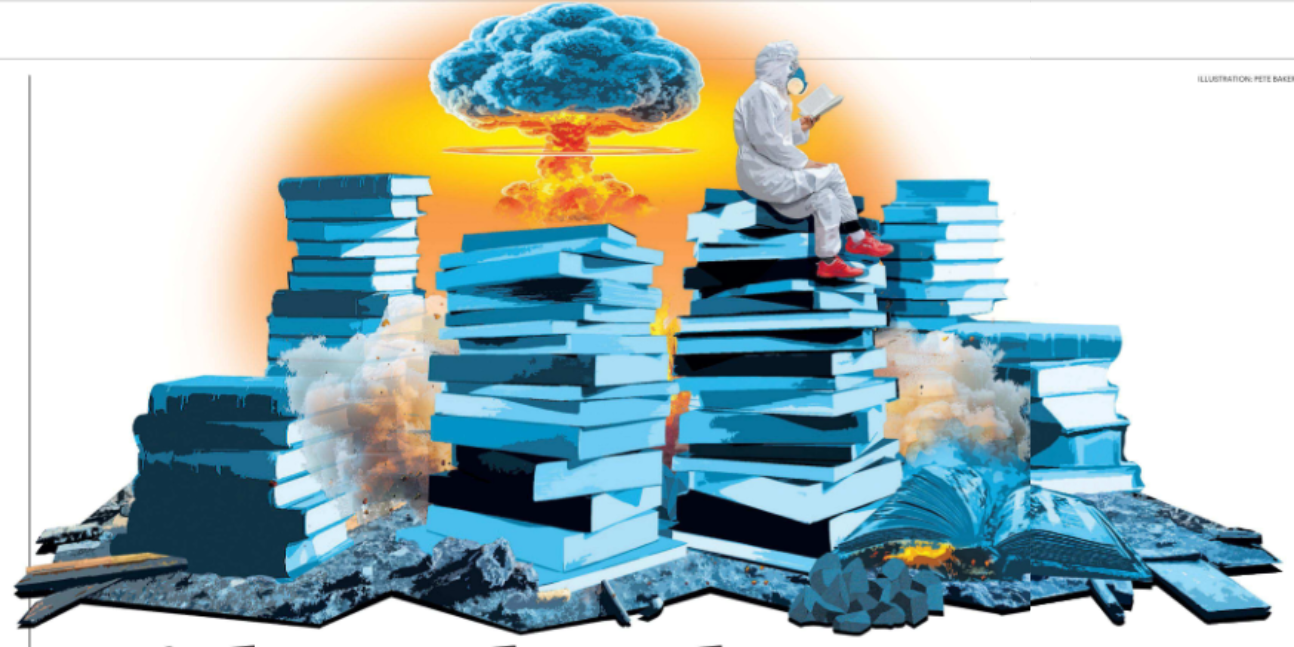
 Without books, we might go back to being barbarians

Western society seems to have forgotten why we moved on from cave paintings: reading has never been more vital in making sense of a complex world, argues Niall Ferguson

In Ray Bradbury’s best-known novel, the dystopian classic Fahrenheit 451, he combined the memory of Nazi book burnings with the experience of Joseph McCarthy’s “red scare” to imagine a future America where firemen are employed not to put out fires, but to start them in any home where illicit book reading is detected.

Bradbury naturally assumed that any society where books were generally prohibited would be a totalitarian one. The unnamed city he imagines in his 1953 novel is in many respects an American version of George Orwell’s London in Nineteen Eighty-Four. What makes it distinctively American is that the authoritarian regime is combined with a hedonistic consumer society very different from the austerity of Orwell’s dystopia.

Guy Montag, the central character of Fahrenheit 451, is a fireman married to mindless Millie, who flees serious thought or conversation with the assistance of sleeping pills, giant flat-screen televisions and what we would now call earbuds. Millie and Guy live under a government that is actively trying to deprive its people of the power to think by eradicating books, the vessels of knowledge.

What Bradbury failed to anticipate is that his native America — and indeed the western world — might turn away from literacy voluntarily, without the need for political tyranny.

The consumer society has turned out to be enough to make us turn away from books. And turn away fast.

The evidence has been accumulating for some time that we are no longer choosing to read. A study, based on the US government’s Time Use Survey of 236,000 Americans, found that the proportion of those who read for pleasure has fallen dramatically since the turn of the century. On an average day in 2004, 28 per cent of Americans would read; by 2023, that had fallen to 16 per cent.

According to a 2022 survey, 52 per cent of Americans hadn’t read a book in more than a year. Ten per cent hadn’t read a book in more than ten years.

This continues a long-running decline. The percentage of adults who read any literature not required for work or school fell from 57 per cent in 1982 to 43 per cent in 2015.

One in five Britons aged between 16 and 65 can read only at or below the level expected of a ten-year-old, according to a significant new study of literacy rates across the developed world by the Organisation for Economic Co-operation and Development (OECD).

But the real concern is the decline of reading among young people. In 2022 American baby boomers read more than twice as many books per year as millennials and Gen Zers. According to a 2025 study, only 14 per cent of 13-yearolds reported reading for fun almost every day in 2023, a dramatic fall from 30 per cent in 2004 and 37 per cent in 1992.

The story is the same in Britain. According to the National Literacy Trust, the percentage of children and young people who say they enjoy reading has fallen to its lowest level in 20 years. Just one in three Britons aged between eight and 18 enjoy reading in their free time — a 36 per cent decrease in reading since the survey began in 2005. The slump in reading enjoyment has been especially steep among boys aged 11 to 16.

I would be surprised if anyone engaged in the archaic activity of reading this essay were surprised by this data. Because the evidence is all around us.

On the train, the bus or the Tube in London, we see our fellow passengers hunched over their smartphones. In the past, at least some of them would have been clutching books. At home, we fight incessantly with our children over “screen time”, not least because we know it is taking the place of book time. We people of the book hail Jonathan Haidt’s bestseller, The Anxious Generation: How the Great Rewiring of Childhood Is Causing an Epidemic of Mental Illness. Our cure-all remedy for Generation Z’s multitude of mental ailments is to lock them all up in the London Library for a month.

But that’s not a feeling shared by many younger parents. According to a survey by the publisher, HarperCollins, fewer than half of parents of children up to 13 years old say reading aloud to their kids is “fun for me”. Gen Z parents tend to regard reading as “more a subject to learn” than a pleasurable activity.

It’s true, of course, that we are witnessing the rise of the audiobook. (In America, according to Publishers Weekly, revenue from audiobook sales grew by 22 per cent in 2022.) You can quibble about the relative merits of reading to oneself or having another person read a book aloud to you, but it seems clear that audiobooks are allowing us to consume books in ways that previously were impossible — while driving, jogging, biking, even cooking and doing the dishes.

But audiobooks won’t help with the fact that there’s a decline of literacy — the ability to read and write. When people stop reading, they stop being able to read. And I mean that, well, literally.

According to a CBI report in 2017, a third of UK businesses are not satisfied with young people’s literacy skills when they enter the workforce.

And when people stop being able to read — to make sense of the meaning of text on a page — they also lose the ability to make sense of the world.

At stake here is nothing less than the fate of humanity, given the intimate connection between the written word and civilisation itself. In the beginning was the word. And in the end? At first, the written word seemed to do remarkably well in the internet age. The World Wide Web was essentially a network for web pages largely composed of text, with a modest amount of illustrative art, linked together by text URLs. Google searches for text. Most Facebook posts were written. The same goes for most X posts.

Three things are now rapidly eroding the dominance of text. First, encouraged by the peculiar difficulty of the iPhone keyboard, there’s the rise of the emoji, which is in reality a return to the pictograph, a primitive pre-alphabetic form of written communication.

Then comes the ascendancy of audio and video, epitomised by the proliferation of podcasts and the rise of TikTok. The important change here is the death of the script. Until recently, nearly all entertainment on radio and television, and in the cinema, started out as written words. Only in the past decade has improvised chatter driven out carefully crafted lines of dialogue.

The emoji is a return to the pictograph — a primitive pre-alphabetic form of written communication 

Finally, though artificial intelligence remains largely text-based — because most prompts still have to be typed out — that is starting to change. Inputs are increasingly spoken ... we can just ask Siri. Which brings us to the next phase: outputs, too, are increasingly non-textual.

Think of the current effort by OpenAI to promote Sora 2 — which generates videos from text prompts — and is clearly seen as a potential money-spinner.

In short, we are moving rapidly toward a future where information will be shared via spoken words and images, not text, with computer code as the language spoken by computers to one another, intelligible only to a minority of humans.

Why did people find it necessary to go beyond cave paintings and pictographs? The answer is that a society of any commercial complexity cannot function on the basis of emojis.

Five millennia ago, cuneiform writing was first used in southern Mesopotamia as a means of keeping accounts. Property rights also required written records. The first codes of law appeared in Mesopotamia around 2100BC, exemplified in the Code of Hammurabi (about 1750BC), which was inscribed on stone stelae throughout the Old Babylonian Empire.

In other words, without text it is hard to keep track of and communicate the rules that are necessary in a society of any complexity. Literature came later and served a state-building purpose. The Epic of Gilgamesh is an early second-millennium work of epic poetry that glorified a Sumerian king. Scribes ran ancient Egypt for the pharaohs by strictly upholding written traditions — hence the old joke that Egypt was “nation of fellahin [peasants] ruled with a rod of iron by a Society of Antiquaries”. Again, without text, it is hard to keep track of the stories that convey a civilisation’s foundational myths to each successive generation.

Writing was also crucial in the history of monotheism. The Torah, comprising the first five books of the Hebrew Bible, codified the laws of ancient Israel. Not by chance, the Gospel of St John begins: “In the beginning was the Word, and the Word was with God, and the Word was God.” The spread of Islam in the 7th century brought about the rapid establishment of Arabic as a major literary language in much of the Mediterranean and Central Asia.

Without text, it is hard to keep track of the stories that help us understand our purpose in this world and our relationship to the divine.

Of course, for the first three and a half millennia that written language existed, all these stories could be tightly controlled by elites. That did not change until two transformative events in Europe: the advent and rapid proliferation of the printing press, beginning in the 1440s, and the Protestant Reformation, with its insistence that congregations as well as priests should be able to read scripture.

Cheap books and pamphlets were what enabled so many people to learn to read. Protestantism provided the motive to teach them to do so. This was what led to the spread of literacy. And it changed the world as profoundly as the later Industrial Revolution, which would have been impossible without workers who could read.

As literacy grew more widespread, so political participation could also become broader. Later, the abilities to read and write were spread beyond Europe by colonisation, commerce and, especially, by Protestant missionaries.

Literacy was not intended to enable people to think for themselves. But that was its effect. And that’s not all it did.

In a brilliant 1963 essay, “The Consequences of Literacy”, the anthropologist Jack Goody and the literary critic Ian Watt argued that the invention of writing, most decisively in ancient Athens, was a fundamental turning point. It was “only then that the sense of the human past as an objective reality was formally developed, a process in which the distinction between ‘myth’ and ‘history’ took on decisive importance”.

There emerged for the first time “the notion that the cultural inheritance as a whole is composed of two very different kinds of material; fiction, error, and superstition on the one hand; and on the other, elements of truth which can provide the basis for some more reliable and coherent explanation of the gods, the human past, and the physical world”.

When you read this, you see that our growing susceptibility to fake news and conspiracy theories are less a consequence of changes in mass media, and more a reflection of a fundamental civilisational crisis of literacy.

If we gradually cease to base our social and political organisation on the written word, it follows that there will be three consequences.

First, we shall quickly be cut off from the heritage of all the great civilisations, as books are the principal repository of past thought. Books are the principal way a civilised person learns about the distinction between noble and ignoble conduct, for example. This means that the next generation will have a significantly larger proportion of outright barbarians than any in the past century.

Second, we shall revert to the preliterary conflation of present and past, history and myth, individual and collective. The essence of the conspiracy theory is that it preys on the illiterate mind.

Third, we shall quickly lose the ability to think analytically, because the crucial way our civilisation has been transmitted from generation to generation is through the great writers, from whom we learn how to structure an argument so that it is clearly intelligible to others.

Bradbury’s Fahrenheit 451 offered a vision of a bookless, authoritarian future. But the more I think about where we’re going, the more I realise that the loss of literacy will amount to going back in time rather than forward.

This is an edited version of a piece that first appeared in the Free Press